

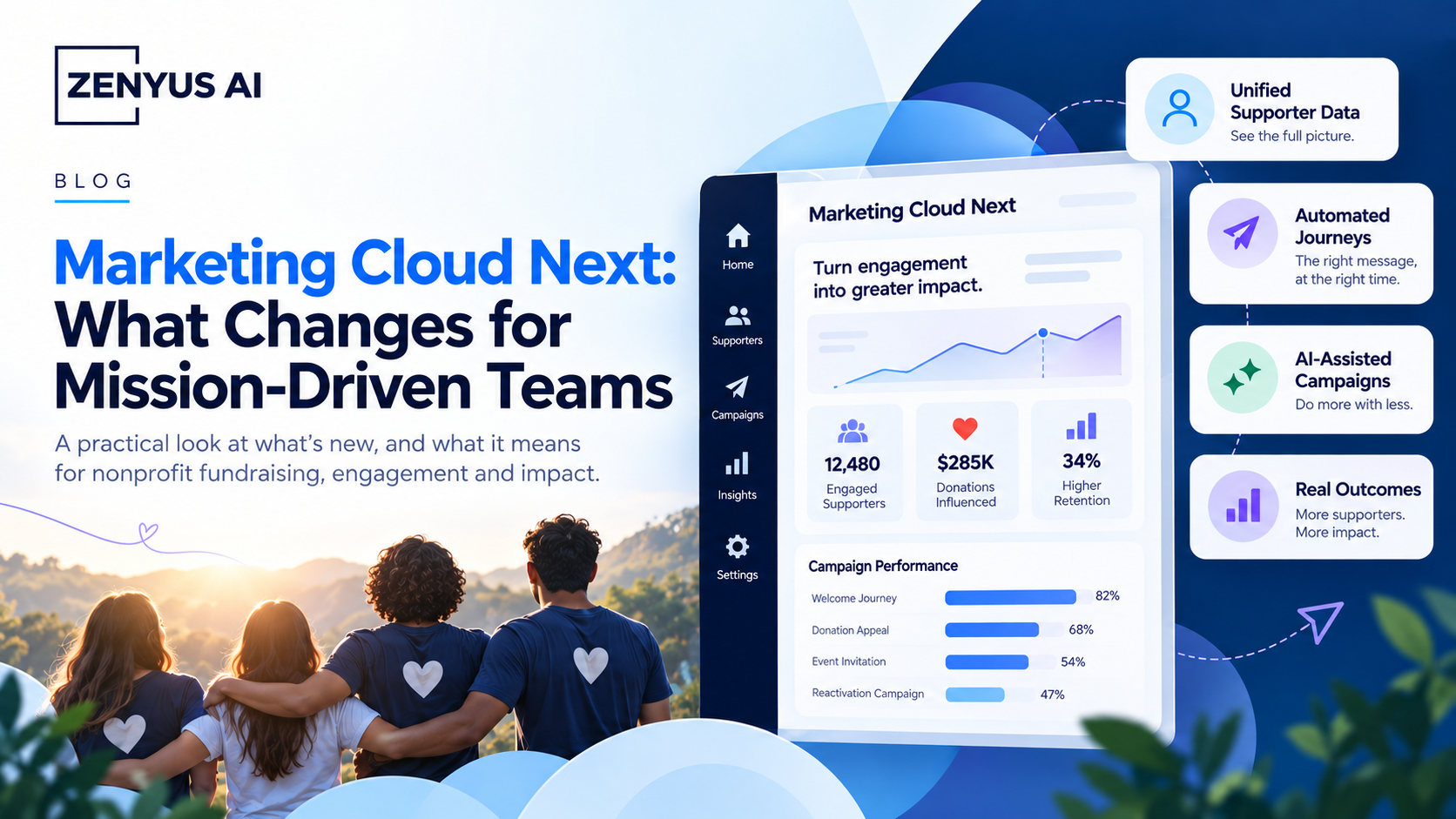
Marketing Cloud Next: What Changes for Mission-Driven Teams

Marketing Cloud Next is a rebuild, not an upgrade. See what changes for nonprofits, aged care providers and public sector teams: unified data, live segmentation, governed AI and reporting tied to outcomes.
Ask a mission-driven marketing team what they need, and the answer is rarely "more tools."
They need time. They need clean data. They need to know which supporter, family or citizen needs to hear from them today, and what to say. They need to do it with three people, a tight budget and a board that wants proof it worked.
That is the reality Marketing Cloud Next is designed for.
Marketing Cloud Next is not an upgrade to the old Marketing Cloud. It is a rebuild, native to the Salesforce platform, running on Data 360 and Agentforce. For nonprofits, aged care providers and public sector teams, it changes what a small team can do.
This article covers what actually changes, why it matters for mission-driven work, what to watch out for, and how to start.
The problem with the old way
Most mission-driven organisations have lived with the same set of frustrations:
- The CRM and the email tool don't agree. Donors, members, clients and residents' families are recorded twice, differently.
- Lists go stale. By the time a segment is exported and uploaded, the person has already changed.
- Every campaign is manual. Building audiences, writing variants and scheduling sends eats the week.
- Specialists are a bottleneck. Only one person understands the marketing platform, and they are always busy.
- Reporting stops at opens and clicks. Nobody can connect a campaign to a donation, a service enquiry or an outcome.
- Consent lives in a spreadsheet. For organisations working with vulnerable people, that is a risk, not a workaround.
None of this is a failure of the team. It is what happens when marketing lives beside the CRM instead of inside it.
Seven things that change
1. One platform, one record of truth
Classic Marketing Cloud lived beside your CRM and needed syncs, data extensions and workarounds to talk to it. Marketing Cloud Next sits on the same platform as your CRM. Donors, members, clients and campaign responses share one data model.
What changes:
- No more duplicate lists
- No more overnight sync failures
- One view of every relationship, visible to marketing, fundraising, service and programme teams
Why it matters: when everyone works from the same record, you stop arguing about whose data is right and start acting on it.
2. Data 360 powers segmentation
Segments are built on unified profiles from Data 360. You can combine donation history, event attendance, service interactions and web behaviour in a single audience. Segments update as behaviour changes, so "lapsed in 12 months" stays accurate without a manual refresh.
Segments worth building first:
- First-time givers who haven't given again
- Monthly donors showing early signs of drop-off
- Volunteers who have never donated
- Family members of clients who haven't engaged in six months
- Citizens who started a service application and didn't finish
Why it matters: you stop building audiences by hand and start responding to moments as they happen.
3. Agentforce for marketing
AI is built into the workflow instead of bolted on.
- Campaign creation: describe the goal and audience, and get a draft campaign, journey and content brief.
- Content generation: subject lines, email copy and variants, grounded in your data and governed by your brand rules.
- Optimisation: suggestions on timing, audience and messaging based on performance.
Your team reviews and approves. The agent handles the first draft.
Why it matters: the blank page is the slowest part of any campaign. Removing it gives small teams back their week, while your people keep the judgement, the voice and the final say.
4. Real-time personalisation
Messages respond to what a supporter just did, not what they did last week. A first-time donor, a monthly giver and a volunteer receive different next steps automatically, across email, SMS and WhatsApp.
What that looks like:
| Person | What just happened | Next step |
|---|---|---|
| First-time donor | Made a first gift | Welcome and impact story, then a gentle path to giving again |
| Monthly giver | Reached 12 months | Thank-you and recognition, not an ask |
| Volunteer | Completed a shift | Appreciation and an invitation to a fundraising event |
| Family member | Attended a care review | Relevant information, not a fundraising appeal |
Why it matters: the right message at the right moment builds trust. The wrong one erodes it.
5. Journeys built on Flow
Journeys use the same Flow tooling your Salesforce admins already know. Marketing, fundraising and service teams can trigger and share automation without specialist Marketing Cloud skills.
What changes:
- Fewer single points of failure
- Faster changes when priorities shift
- Shared automation across teams, instead of each team building its own
Why it matters: your marketing capability no longer depends on one person's calendar.
6. Governance and trust
Consent, preferences and data-use rules live in the platform. For organisations handling sensitive data (aged care, child safety, public sector), guardrails are part of the design, not an afterthought.
What good governance looks like:
- Consent captured once and applied to every campaign and channel
- A preference centre that lets people choose what they hear and how
- Clear rules on which data can and can't be used for which purpose
- Human review on AI-generated content before it goes out
- An audit trail you can point to when asked
At Zenyus, our approach is mission first, platform second.
Why it matters: the people you serve trust you with their stories, their money and their vulnerability. Your marketing should honour that.
7. Reporting that connects to outcomes
Campaign performance sits next to donations, cases and programme data. You can answer "did this campaign move the mission?" and not just "what was the open rate?"
Questions you can finally answer:
- Which campaign brought in donors who kept giving?
- Did our reactivation journey lift retention or just clicks?
- Which communications reduced enquiries to the service team?
- Where are families or citizens dropping out of the process?
Why it matters: boards, funders and government partners want evidence of impact. Connected reporting makes it possible.
What this means in practice
| If you are... | Marketing Cloud Next gives you... |
|---|---|
| A nonprofit fundraising team | Donor journeys, reactivation and lapsed-giver campaigns from one data source |
| An aged care provider | Compliant, personalised communication with families and residents |
| A public sector agency | Governed, multi-channel citizen engagement |
For nonprofits
Fundraising depends on noticing. Noticing the first gift, the second gift, and the moment a regular supporter goes quiet. With one supporter record and live segments, small teams can run lifecycle journeys that once needed a much larger team. Explore how we support non-profit organisations.
For aged care providers
Communication with families and residents has to be timely, respectful and compliant. Connected data and built-in consent management let you send the right update to the right person, without exposing information that should stay private. Explore how we support aged care providers.
For public sector agencies
Citizens expect clear, consistent communication across channels. A governed platform lets agencies reach people through email, SMS and WhatsApp with consistent data and clear accountability. Explore how we support the public sector.
Is it right for you?
Marketing Cloud Next suits organisations that already run Salesforce, want marketing and CRM in one place, and need AI they can govern.
It is likely a strong fit if you:
- Run Salesforce today, or plan to
- Manage supporter, client or citizen data across several systems
- Have a small team stretched across too many manual tasks
- Handle sensitive data and need clear governance
- Want to prove impact to boards, funders or government partners
If you are on classic Marketing Cloud or a separate email tool, migration is the first decision, and we can map it out for you.
How to start
Step 1: Discover. A short, structured discovery aligns your teams on data, integrations, consent and priority journeys. It ends with a prioritised backlog and a phased roadmap. Our Salesforce Advisory team leads this.
Step 2: Build the foundation. Connect data, model supporters, clients and accounts correctly, and configure consent and governance. Our Implementation team takes the roadmap through to delivery.
Step 3: Launch priority journeys. Start with the moments that matter most: welcome, reactivation and retention.
Step 4: Measure, tune and expand. Use results to improve, then add journeys and channels. Our Managed Services team keeps it performing.
You can see how this works in practice on our success stories page.
Small team, bigger memory
Mission-driven teams have never lacked purpose. They have lacked time, connected data and tools that work as hard as they do.
Marketing Cloud Next changes that. It gives small teams a shared memory of every relationship, the ability to act at the right moment, AI that drafts while people decide, and reporting that proves the difference.
Zenyus AI helps nonprofits, aged care providers and public sector organisations across Australia and New Zealand implement Salesforce Marketing Cloud Next with mission first, platform second.
Ready to see it in action? Book a discovery call with Zenyus AI.
Priyal Sonkiya
Priyal Sonkiya is the Head of Marketing at Zenyus AI, focusing on strategic brand positioning, UI/UX storytelling, and building authentic, high-impact digital experiences for the nonprofit and public sectors.
Frequently Asked Questions
- Is Marketing Cloud Next the same as classic Marketing Cloud?
- No. It is a rebuild, native to the Salesforce platform and running on Data 360 and Agentforce, rather than a separate system connected by syncs.
- Do we need Data 360?
- Marketing Cloud Next is built on Data 360, which provides unified profiles and live segmentation. Your licensing and data volumes will shape the right setup.
- Can a small team run it?
- Yes. Journeys use familiar Flow tooling and AI reduces campaign effort. Scope matters more than team size.
- Will AI send messages without our approval?
- No. Your team reviews and approves AI-generated content. Governance and review steps should be designed into the process from the start.
- How does it handle consent and privacy?
- Consent, preferences and data-use rules live in the platform and apply across campaigns and channels. Implementation should be designed around your privacy obligations from day one.
- What channels does it support?
- Email, SMS and WhatsApp, with journeys that respond to behaviour across them.
- What if we're on classic Marketing Cloud today?
- Migration planning is the first step. It covers data, consent, journeys and continuity, so your supporters, families or citizens don't notice the switch.
- How long does implementation take?
- It depends on your data, systems and channels. A discovery conversation is the fastest way to scope it.
Explore Zenyus
Continue your Salesforce and nonprofit digital transformation journey with our tools, stories, and resources.
Ready to Transform Your Salesforce Strategy?
Let our Certified Technical Architect guide your digital transformation with proven expertise.
Related Articles
How Salesforce Marketing Cloud Next Is Changing Nonprofit Fundraising
See how Salesforce Marketing Cloud Next helps nonprofits unify donor data, automate journeys and reactivate lapsed supporters, with AI you can govern.
Sold Out Is Not the Finish Line: How Marketing Cloud Next Turns Ticket Buyers into a Loyal Audience
How Salesforce Marketing Cloud Next helps festivals and arts nonprofits know their ticket buyers, recover lost sales and grow repeat audiences.