

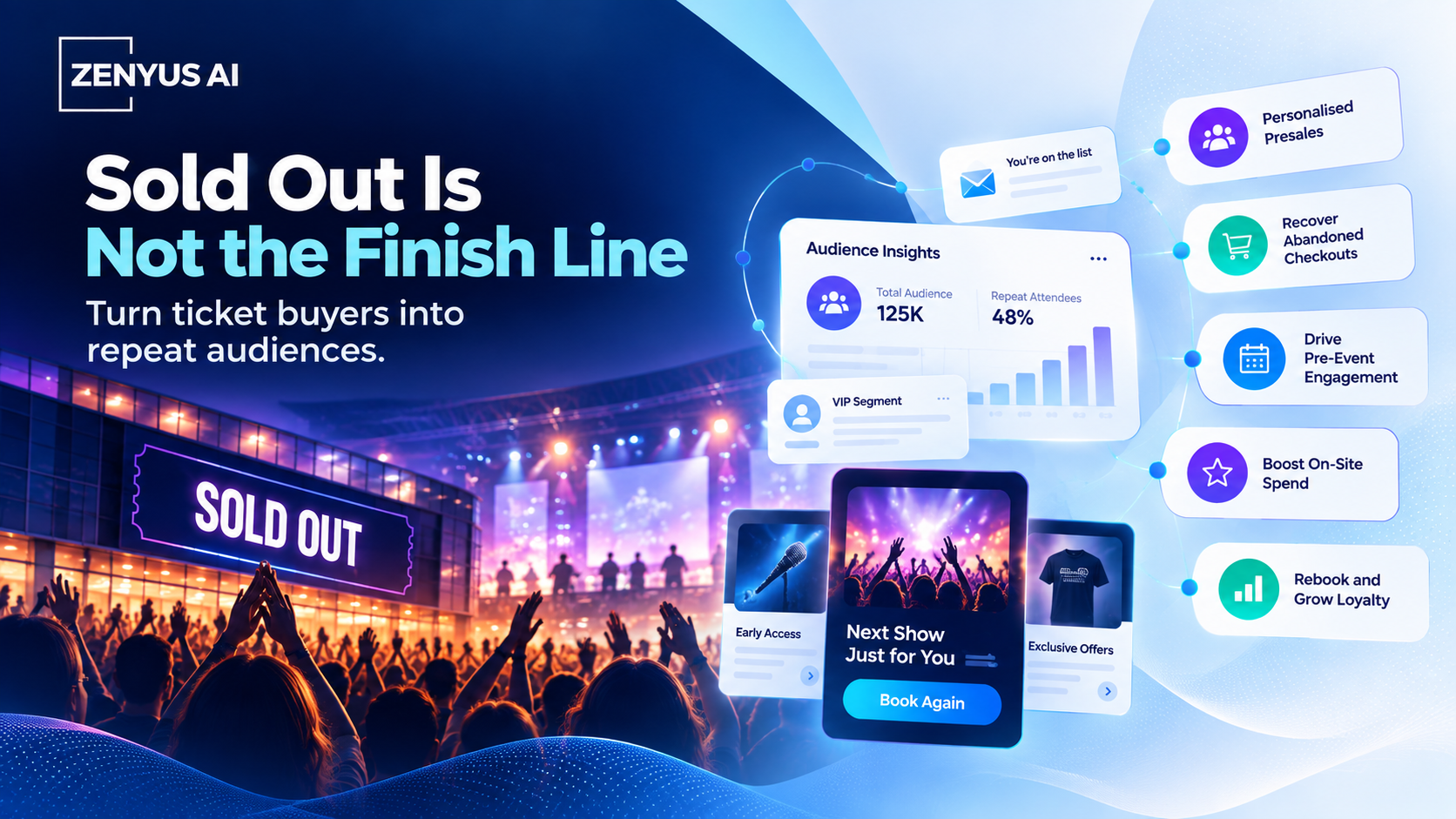
Sold Out Is Not the Finish Line: How Marketing Cloud Next Turns Ticket Buyers into a Loyal Audience

How Salesforce Marketing Cloud Next helps festivals and arts nonprofits know their ticket buyers, recover lost sales and grow repeat audiences.
The season closes and ticket sales are up. Then a board member asks the quieter question: how many of those people were new, and how many will come back?
For many festivals and arts organisations, the honest answer is "we'd need to pull reports from three systems." A third-party ticketing platform holds the orders. Venues and promoters hold their own lists. Group bookers, first-timers and loyal regulars all look the same: a transaction.
For a not-for-profit, that gap costs more than revenue. Ticket income funds artists and programming. Audience data backs up your grant acquittals and sponsor conversations. Your next member or donor is probably already in your order history. You just can't see them.
This article covers where that value leaks and how Salesforce Marketing Cloud Next closes each gap.
Where the value leaks
| The leak | What causes it | What closes it |
|---|---|---|
| Anonymous buyers | Orders from ticketing partners, resale and box office sit in separate systems | Data 360 identity resolution merges them into one buyer profile |
| One-and-done attendees | No follow-up after the event | Journeys triggered by attendance invite buyers back |
| Late, lumpy demand | One loud on-sale, then silence | Presale and staged journeys build demand over time |
| Missed add-ons | Offers go to everyone or no one | Behaviour-based segments target likely buyers |
| Abandoned checkouts | No signal when a buyer drops out | Triggered recovery messages |
| Invisible groups | Group and corporate bookers treated as single buyers | Account and contact modelling |
| Lapsed regulars | Nobody notices the gap | Inactivity segments start win-back automatically |
| Unseen supporters | Frequent attendees never asked to join, give or become members | Segments identify them and journeys make the ask |
| Consent chaos | Preferences live in spreadsheets | One consent and preference record applied to every send |
How it works
1. Know the buyer (Data 360)
Everything else depends on this. You connect:
- ticketing and box-office orders
- partner and resale data, where shared
- attendance records
- web and app behaviour
- add-on purchases
- consent and preferences
Identity resolution then matches records that belong to the same person, even when the name or email differs slightly. Calculated insights turn the raw data into measures you can use, such as events attended, time since last purchase and preferred genre. The buyer who purchased through a partner in March, the box office in June and your website in September becomes one person, not three.
2. Find the moment (segments)
Segments are rules that update as behaviour changes: attended two or more events this year, bought once and never returned, abandoned checkout in the last 24 hours, booked six or more tickets. Nobody exports a list. How fresh a segment is depends on your data feeds and publish schedule, which we plan for during design.
3. Act automatically (journeys on Flow)
A journey starts from a trigger such as a purchase, an attendance record or a segment entry. It sends email, SMS or WhatsApp where enabled and matched to preference, then branches on what the buyer does next. Because it's built on Flow, your Salesforce admins already know the tooling.
4. Create faster (Agentforce)
Agentforce can draft campaigns, copy and variants from a brief, grounded in your data and brand rules. Your team reviews and approves everything before it sends. For a small marketing team, this is what makes a tailored campaign for every show possible, not just the headline acts.
5. Stay trusted (consent and preferences)
Permissions sit on the buyer profile and are respected by every journey. A preference centre lets people choose which events, genres and channels they hear about. This matters under the Spam Act and Privacy Act, and it keeps people subscribed.
6. Prove it (reporting)
Results sit next to orders and attendance, so you can see which journey drove which ticket sale, not just which email was opened. That is the evidence boards, funders and sponsors ask for.
Seven journeys worth building
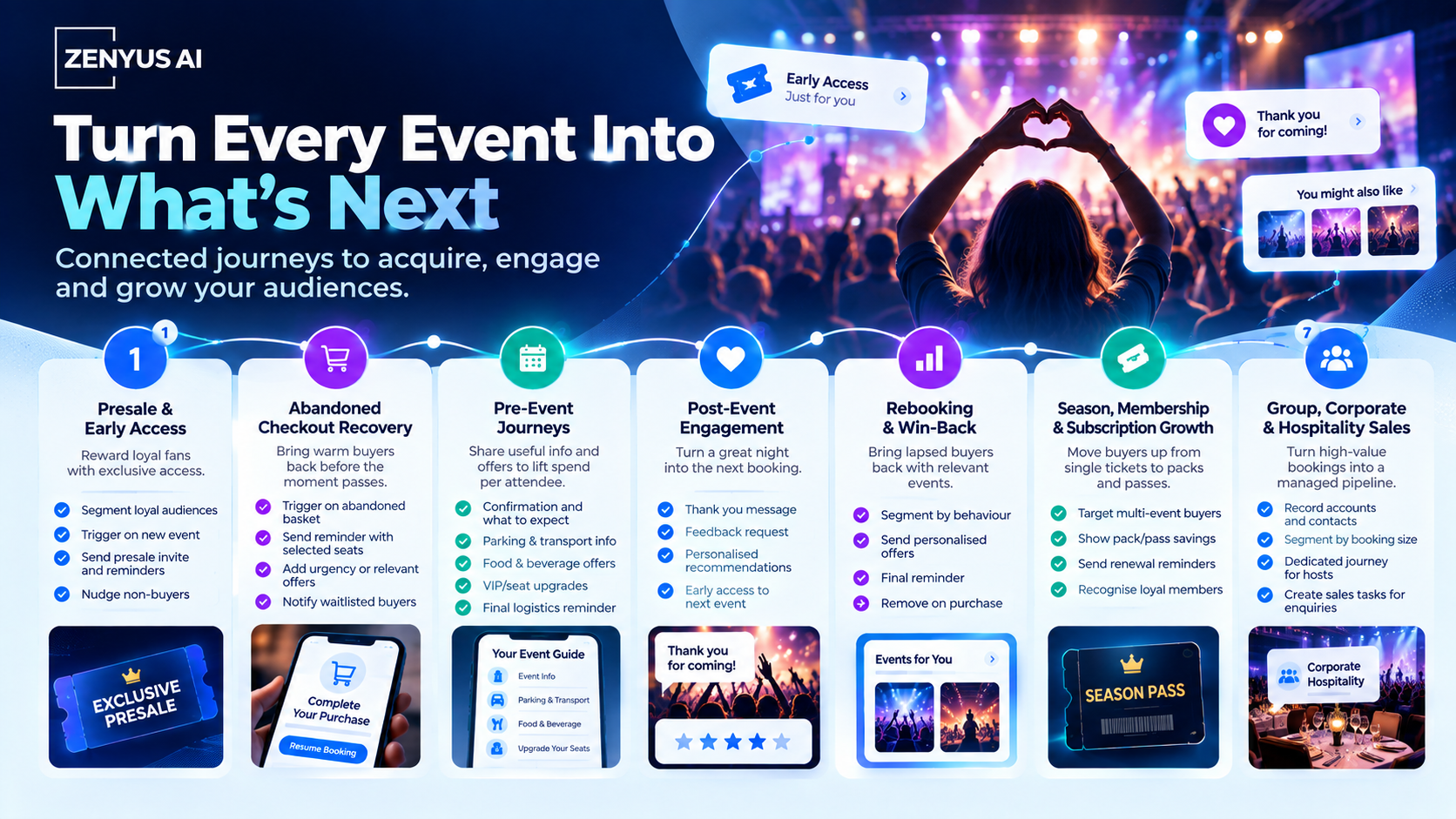
Presale and early access. Segment past attendees, members or genre buyers and invite them first with a unique link. Send a reminder before presale closes, then announce the general on-sale. Loyal audiences feel recognised and early momentum builds without discounting.
Abandoned checkout and waitlist recovery. When a basket is created but no order completes, send a reminder showing the exact tickets they selected. Follow with a second message if inventory is low. When seats are released, notify the waitlist in sign-up order. This recovers demand you've already paid to generate.
Pre-event journeys. Between purchase and doors, most buyers hear nothing. A simple sequence works well: confirmation, then transport and food pre-order information, then a seat or VIP upgrade offer for eligible tickets, then a logistics reminder. Add-ons go only to buyers who haven't bought them. Expect fewer "where do I park?" calls.
Post-event journeys. The hour after a show is your best marketing moment. Send a thank-you that evening and a short feedback request the next day. A few days later, recommend similar events. Two weeks on, offer early access to the next relevant show. Low feedback scores route to your service team instead of triggering a sales message.
Win-back by behaviour. Take buyers who attended two or more events but have been quiet for ten months. Send a personal message referencing what they loved and a relevant upcoming event. Anyone who books is suppressed immediately.
Membership, giving and supporter growth. Segment buyers who've attended several events on single tickets. Show them what a pack, pass or membership would have saved, right after their latest attendance. For not-for-profits, the same logic applies to a donation ask, and it's where Marketing Cloud Next and Nonprofit Cloud work together. A frequent attendee with no giving history is a warm prospect, not a cold one.
Group, corporate and partner sales. Record group hosts and corporate buyers as accounts with linked bookings. Give them a dedicated journey with early package access and rebooking prompts. High-value enquiries create tasks for your sales or partnerships team in Salesforce. For sponsors and venue partners, the same model gives you a shared view of audience reach.
Our hospitality work followed the same principle for a multi-property B2B journey: define the customer clearly first, then build the journeys. The hospitality version of this article covers it in more depth.
One buyer, one season
Meet Amelia. She buys two tickets to a comedy show through a partner site.
| When | What happens | What's at work |
|---|---|---|
| Purchase | Her order matches an earlier box-office record | Identity resolution |
| Purchase | She joins the "comedy buyers" segment | Segmentation |
| 2 weeks before | She gets transport info and a food pre-order offer | Pre-event journey |
| Show night | Her attendance is recorded | Event data |
| Same evening | She receives a thank-you | Post-event journey |
| 3 days later | She sees two upcoming comedy shows recommended | Recommendations |
| 2 weeks later | She gets presale access to the comedy festival | Segment-triggered presale |
| After three more events | She's offered a pack and invited to give | Membership and giving journey |
| Year two, 10 months quiet | She receives a win-back message | Win-back journey |
Nobody scheduled any of this by hand. Each step was triggered by something Amelia did.
What has to be true first
- Clean buyer identity: matching rules tuned to your data
- Reliable data feeds: orders, attendance and add-ons arriving on a schedule that supports the journeys you want
- Consent at every entry point: including third-party sales, where permitted
- B2B modelling: for groups, corporate hosts and partners
- Clear ownership after go-live: journeys need ongoing tuning
This is the work that decides whether journeys perform, and it is the work most often skipped.
What to measure
Set baselines before launch, or the lift won't be convincing. Track:
- repeat purchase rate and time between events
- first-time to second-time conversion
- direct versus third-party sales share
- checkout recovery rate
- revenue per attendee
- membership and giving conversion
- group rebooking rate
- campaign build time
Mistakes to avoid
- Personalising before unifying data
- Treating every event the same. A comedy crowd and a classical crowd want different journeys.
- Marketing only at on-sale
- Ignoring third-party buyers
- Forgetting groups and corporate hosts
- Launching everything at once
- Having no owner after go-live
Where to start
Build three journeys first:
- Abandoned checkout recovery: fast to build, with direct revenue impact.
- Post-event thank-you and recommendation: turns first-timers into repeat buyers.
- Lapsed buyer win-back: reactivates an audience you've already paid to acquire.
Add presale, add-on, membership and giving journeys as the foundations settle.
Make every ticket the start of something
A sold-out night is a great result. A sold-out night that brings the same audience back, with friends, for the next three shows, is a sustainable organisation.
The events that win won't be the ones that announce loudest. They'll be the ones that know their audience best and act on it.
Zenyus AI helps festivals, venues and arts organisations build the data foundations and journeys that turn buyers into audiences. Book a consultation to see what your ticket buyer journey could look like, or explore our Salesforce Advisory, Implementation and Managed Services.
Priyal Sonkiya
Priyal Sonkiya is the Head of Marketing at Zenyus AI, focusing on strategic brand positioning, UI/UX storytelling, and building authentic, high-impact digital experiences for the nonprofit and public sectors.
Frequently Asked Questions
- Can this connect to our ticketing platform?
- Usually, yes. Order, event and attendance data can be brought into Data 360. The right approach depends on your platform and what it exposes.
- We sell through third parties. Can we still know our buyers?
- Partially, in most cases. It depends on what partners share and what consent is captured. Discovery clarifies what's achievable.
- How does it know two records are the same person?
- Identity resolution uses matching rules on email, phone and name, tuned to your data during implementation.
- How fast can an abandoned checkout message go out?
- That depends on how quickly basket data reaches the platform. Near-real-time feeds can support messages within minutes. Discovery confirms what your ticketing system supports.
- Will AI send messages without our approval?
- No. Your team reviews and approves AI-generated content before anything goes out.
- Is this only for large festivals?
- No. Smaller companies, theatres and clubs benefit too. Scope and phasing matter more than size.
- Is there nonprofit pricing?
- Salesforce offers nonprofit discounts, and the Power of Us programme includes free licences. Which products qualify changes, so we check current eligibility during advisory.
- What if we already use another marketing platform?
- Migration planning comes first, covering data, consent, journeys and continuity, so buyers don't notice the switch.
Explore Zenyus
Continue your Salesforce and nonprofit digital transformation journey with our tools, stories, and resources.
Ready to Transform Your Salesforce Strategy?
Let our Certified Technical Architect guide your digital transformation with proven expertise.
Related Articles
How Salesforce Marketing Cloud Next Is Changing Nonprofit Fundraising
See how Salesforce Marketing Cloud Next helps nonprofits unify donor data, automate journeys and reactivate lapsed supporters, with AI you can govern.
Marketing Cloud Next: What Changes for Mission-Driven Teams
Marketing Cloud Next is a rebuild, not an upgrade. See what changes for nonprofits, aged care providers and public sector teams: unified data, live segmentation, governed AI and reporting tied to outcomes.