

De-Risking Your AFNP Migration: A Business Leader’s Guide

How to protect data integrity, control costs, and maximize ROI when migrating to Salesforce’s next-generation nonprofit platform.
For nonprofit executives and operations leaders, the migration from NPSP to Agentforce for Nonprofit (AFNP) is no longer a question of "if" - now it’s a question of when and how much it will cost to get it wrong. Salesforce has signaled AFNP as the definitive future of its nonprofit portfolio. NPSP is not receiving improvements and only light community driven bug fixes.
💡 Organisations that delay risk falling behind on platform capabilities, security updates, and AI integrations that are already driving fundraising and program efficiency gains.
This guide gives decision-makers a clear-eyed view of the migration process-what it costs, what risks to manage, and how to structure the project for the highest probability of success with minimal operational disruption.
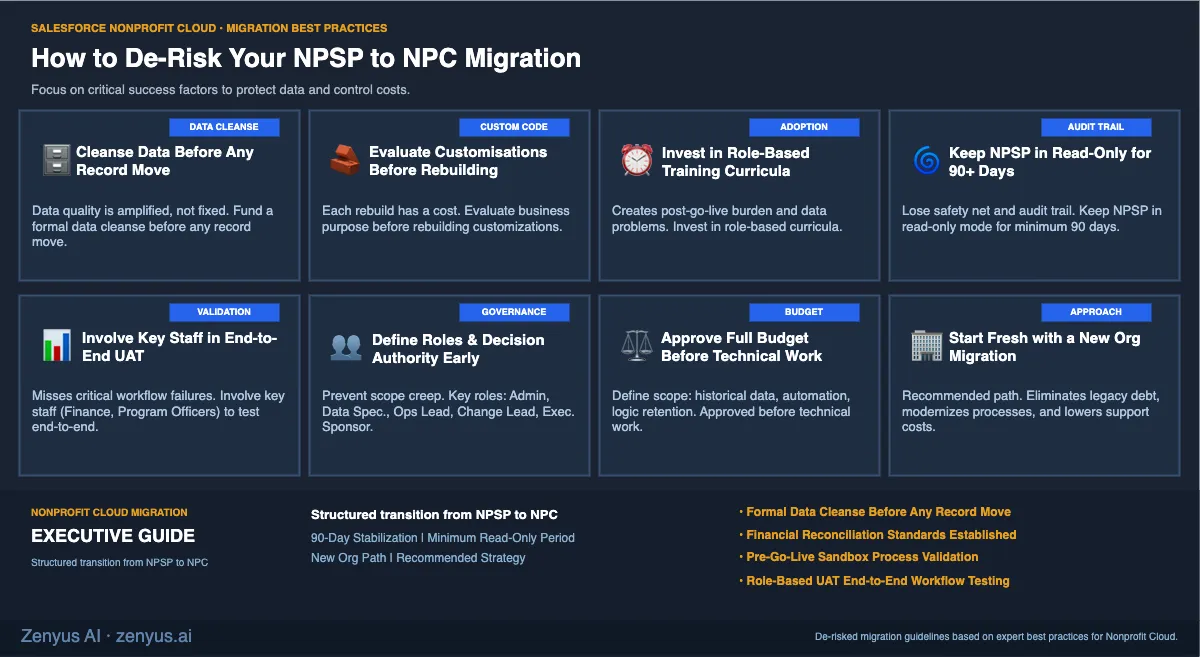
The Business Case: Why Migrating to AFNP Delivers ROI
Before committing budget and resources, leadership needs a clear answer: what does AFNP actually deliver that NPSP cannot? The differences go beyond features-they translate directly into operational efficiency, fundraising capacity, and long-term platform sustainability.
NPSP: Proven, But Reaching Its Limits NPSP has served the sector well for over a decade. However, as a managed package layered on top of Sales Cloud, it carries inherent architectural constraints that increasingly limit what organisations can build and automate. Key capabilities your teams rely on today:
- Household and contact management
- Donation and opportunity tracking
- Grant management
- Recurring gifts
- Rollup summaries and reporting
AFNP: Built for Scale, AI, and the Next Decade AFNP is a ground-up rebuild of Salesforce’s nonprofit offering-a fully native platform, not a bolt-on package. For leadership, this translates into measurable operational advantages:
- Reduced technical debt and lower long-term maintenance costs
- Unified program and fundraising data enabling cross-functional reporting and grant compliance
- Advanced fundraising automation that reduces manual gift processing time
- Native AI and automation (Einstein, Data Cloud) that drives donor retention and staff productivity
- Enterprise-grade scalability that grows with your organisation without costly re-platforming
💡 Executive Takeaway: AFNP is not an incremental upgrade - it is a platform transformation. Organisations that treat it as such from the outset will control costs and timelines. Those that underestimate it will face expensive rework.
Phase 1: Discovery, Risk Assessment & Business Case Validation
Migrations that run over budget almost always trace back to a weak discovery phase. Before any technical work begins, leadership must understand the true scope - and the true cost-of what’s being moved.
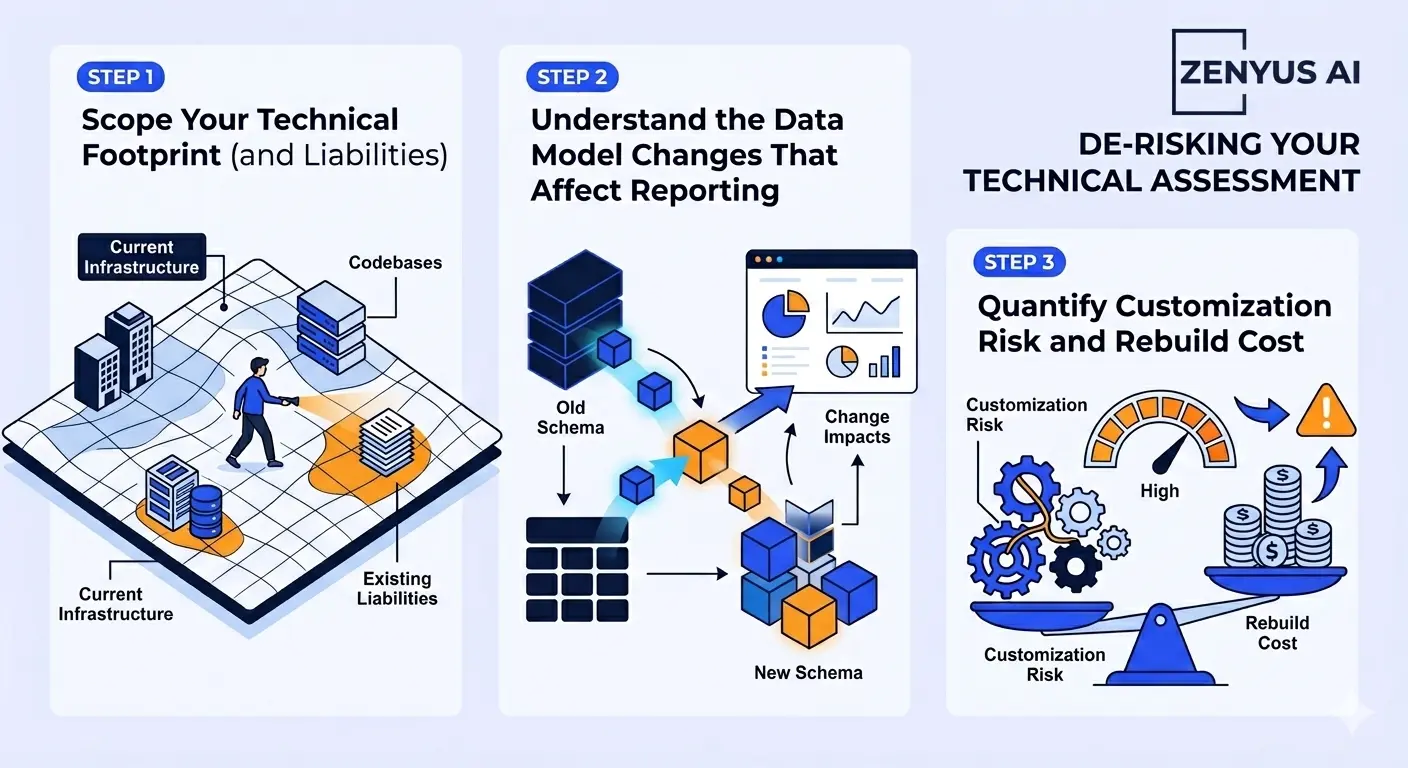
Step 1: Scope Your Technical Footprint (and Liabilities)
A thorough audit prevents cost surprises. Engage your Salesforce admin or partner to document:
- Number of records: Contacts, Accounts, Opportunities, Recurring Donations, Campaigns
- Custom objects and fields built on NPSP
- Apex code, triggers, and custom validation rules
- Third-party integrations (payment processors, email platforms, event tools)
- Reports, dashboards, and list views in active use
- Connected apps and API integrations
Step 2: Understand the Data Model Changes That Affect Reporting
AFNP uses a fundamentally different data model. This affects existing reports, dashboards, and integrations. Ensure finance and program teams understand these changes before go-live:
Key Data Model Changes:
| NPSP Concept | AFNP Equivalent | Impact |
|---|---|---|
| Opportunity (Donation) | Fundraising Transaction | Different field structure and relationships |
| Recurring Donation | Gift Commitment | New object with enhanced tracking capabilities |
| Household Account | Person Account / Household | Different account model requiring data transformation |
| Campaign | Fundraising Campaign | Enhanced campaign management features |
| NPSP Settings | Nonprofit Cloud Settings | Centralized settings management |
| Soft Credits | Gift Credit | More flexible credit allocation |
Step 3: Quantify Customization Risk and Rebuild Cost
Every customization in your NPSP org represents a potential migration cost. Identify and cost out areas where:
- Custom development will need to be scoped and budgeted
- Third-party app vendors must be engaged for compatibility and timeline
- Business processes must be redesigned-a change management cost, not just a technical one
- Staff retraining requires dedicated time and budget allocation
⚠ Important: Every NPSP customization that cannot be replicated natively in NPC must be rebuilt. This is often the largest hidden cost in migration budgets. Identify these early to avoid mid-project scope creep.
Phase 2: Strategic Planning, Budget & Governance
Choose Your Migration Approach (and Understand the Cost Tradeoffs)
There are two primary migration paths. Each has distinct cost, risk, and timeline implications:
Option A: New Org Migration (Best Practice for Most Organisations) A new Salesforce org is provisioned with AFNP, and data is migrated cleanly. This is our recommended approach and avoids the compounding technical debt of an in-place upgrade.
- Advantages: Eliminates legacy technical debt, reduces long-term support costs, enables process modernization
- Tradeoffs: Higher upfront investment; customizations must be intentionally rebuilt (an opportunity to simplify)
Option B: In-Place Upgrade (Limited Access, Higher Risk) Available only to select organisations through Salesforce’s managed migration program. Requires direct engagement with a certified Salesforce partner and Salesforce’s internal team.
- Advantages: Preserves some existing configuration, potentially shorter initial timeline
- Tradeoffs: Higher complexity, greater risk of data conflicts, limited availability-not appropriate for most organisations
📋 Leadership Recommendation: Invest in the new org approach. The higher upfront cost is offset by lower ongoing maintenance expenses and a platform built to scale. Organisations that cut corners here typically pay more in Year 2 and Year 3 rework.
Phase 3: Execution, Data Migration & Change Management
Data Migration Strategy: Clean Data Wins
Migrating data from NPSP to AFNP is not a simple lift-and-shift. The data model differences require a strategic approach to ensure data integrity and reporting accuracy.
Data Migration Best Practices:
- Data Cleansing: Cleanse and deduplicate data in NPSP before migration to avoid carrying over issues
- Data Mapping: Create a detailed data mapping document that outlines field-level transformations
- Staged Migration: Migrate data in stages - test data first, then full migration
- Validation: Validate data in AFNP after migration to ensure accuracy
- Archival Strategy: Determine which historical data to migrate vs archive
⚠ Important: Do not underestimate the time and resources required for data migration. Poor data quality in the source org will result in poor data quality in the target org.
Change Management: The Human Element
Technical migration is only half the battle. Successful AFNP adoption depends on effective change management that addresses user concerns and builds confidence.
Key Change Management Activities:
- Stakeholder Engagement: Involve key stakeholders from all departments early in the process
- Communication Plan: Develop a clear communication plan that outlines timelines, expectations, and benefits
- Training Program: Implement a comprehensive training program tailored to different user roles
- Support System: Establish a robust support system for post-go-live assistance
- Feedback Loops: Create channels for user feedback and continuous improvement
📋 Leadership Recommendation: Allocate at least 20% of the total migration budget to change management activities. Underinvesting in change management is the most common reason for migration failure.
Phase 4: Testing, Deployment & Post-Go-Live Optimization
Comprehensive Testing Strategy
Thorough testing is critical to ensure a smooth transition to AFNP. A multi-layered testing approach will identify issues before they impact operations.
Testing Phases:
- Unit Testing: Test individual components and customizations
- Integration Testing: Test integrations with third-party systems
- User Acceptance Testing (UAT): Involve end-users in testing key workflows
- Performance Testing: Test system performance under load
- Security Testing: Ensure data security and access controls are properly configured
⚠ Important: UAT should involve representatives from all departments that will use AFNP. Their feedback is invaluable for identifying usability issues.
Deployment Planning
A well-planned deployment minimizes disruption to ongoing operations. Consider a phased rollout approach to reduce risk.
Deployment Options:
- Big Bang: All users transition to AFNP at once (higher risk, shorter timeline)
- Phased Rollout: Departments or user groups transition in stages (lower risk, longer timeline)
- Parallel Run: Run both NPSP and AFNP simultaneously for a period (highest cost, lowest risk)
📋 Leadership Recommendation: For most organizations, a phased rollout approach offers the best balance of risk mitigation and timeline efficiency.
Post-Go-Live Optimization
The migration doesn't end at go-live. Continuous optimization ensures you realize the full value of AFNP.
Post-Go-Live Activities:
- Performance Monitoring: Monitor system performance and user adoption
- Feedback Collection: Gather user feedback to identify areas for improvement
- Process Refinement: Optimize workflows based on real-world usage
- Training Reinforcement: Provide ongoing training and support
- Feature Adoption: Encourage adoption of new AFNP features
Making the Business Decision: Is Now the Right Time?
The question for nonprofit leadership is no longer whether to migrate - it is whether to migrate proactively on your own terms, or reactively when NPSP support constraints force your hand!
Organisations that make the move to AFNP now, with proper planning and resourcing, will be fully stabilized on AFNP while others will be scrambling to manage the disruption of transition.
The compounding advantage of early adoption-access to Agentforce, Data Cloud integrations, and native automation - will increasingly separate high-performing nonprofits from those running on legacy infrastructure.
Most importantly, the organisations that succeed treat this as a business transformation, not an IT project. They invest in discovery, staff their teams with the right decision-making authority, hold the line on data quality, and measure adoption as a business outcome. Done right, this migration is not a cost-it is infrastructure for the next decade of mission impact.
📊 Request a Migration Readiness Assessment Contact our team for a structured NPSP-to-AFNP readiness review. We will evaluate your org complexity, quantify migration risk, and deliver a realistic timeline and budget framework-before you commit to a path forward.
About the author
Gourav Sood is a Salesforce Certified Technical Architect (CTA) and founder of Zenyus AI - a Salesforce implementation partner specialising in the nonprofit sector. Gourav has led Salesforce enterprise implementations and delivered complex NPSP-to-AFNP migrations across organisations of all sizes.
Gourav Sood
Salesforce Certified Technical Architect (CTA) with 19+ years of experience in enterprise technology. Gourav specializes in multi-cloud architecture and strategic consulting for the nonprofit and public sectors.
Frequently Asked Questions
- How long does an NPSP to AFNP migration typically take?
- Timeline varies by org size and complexity, but most mid-size nonprofits plan 4–9 months including discovery, data mapping, build, UAT, and cutover. Rushing increases data loss and adoption risk.
- What is the biggest risk in an AFNP migration?
- Poor data quality and unclear business process mapping. Dirty donor records, inconsistent household models, and undocumented workflows cause the most cutover failures.
- Can we run NPSP and AFNP in parallel during migration?
- Yes. Many organisations use a phased approach with a parallel run period to validate reports, integrations, and staff workflows before full cutover.
Explore Zenyus
Continue your Salesforce and nonprofit digital transformation journey with our tools, stories, and resources.
Ready to Transform Your Salesforce Strategy?
Let our Certified Technical Architect guide your digital transformation with proven expertise.
Related Articles
Salesforce NPSP vs. Agentforce for Nonprofit
NPSP vs Agentforce for Nonprofit: understand the real differences in architecture, data model, and capabilities and how to choose the right platform for your organisation’s future

Agentforce for Nonprofit - Best Practices
Stop treating Agentforce for Nonprofit as a technical upgrade. Discover the strategic framework that helps nonprofits harness AI-powered constituent engagement and maximise mission delivery.