Cookie preferences

Key Takeaways from Saleforce Headless 360 Announcement
Salesforce Headless 360 opens every layer of the platform — data, business logic, orchestration, and engagement
Executive summary
The headline announcement at TDX 2026 was Salesforce Headless 360 — the most significant architectural pivot in Salesforce's 27-year history. The core message: the entire Salesforce platform is now an API, an MCP tool, or a CLI command. No browser required. This isn't just a developer feature drop. It's Salesforce restructuring itself for the agentic era — exposing capabilities that have historically lived behind screens so that AI agents can access them directly, in whatever stack your team is already using. Here's what you need to know to get the basics right.
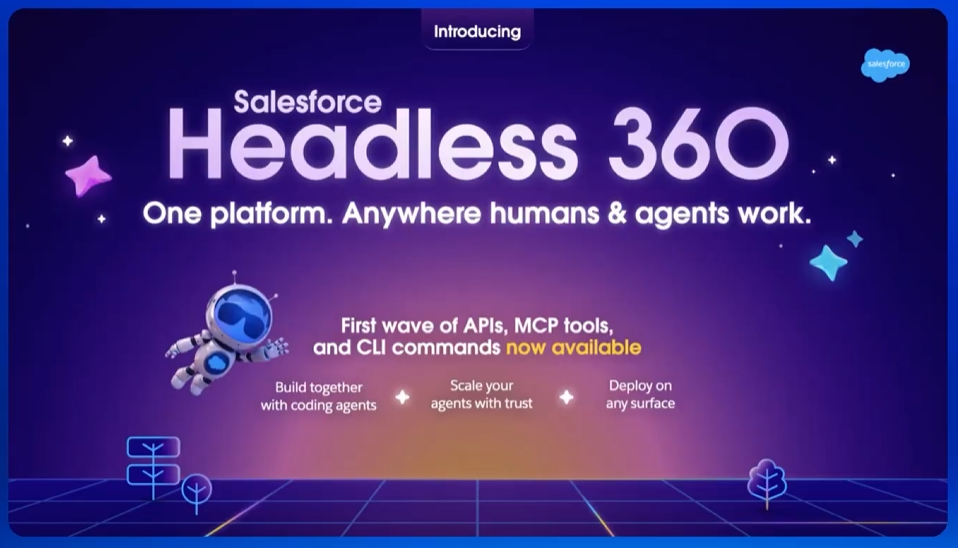
What is Headless 360?
Salesforce Headless 360 was officially announced on April 15, 2026, at TrailblazerDX in San Francisco. The concept is straightforward: the API is the UI. Every capability Salesforce has built over 25 years — CRM workflows, service processes, approvals, compliance controls — is now accessible as an API endpoint, an MCP tool, or a CLI command. AI coding agents like Claude Code, Cursor, Codex, and Windsurf can reach into the full platform without ever touching a browser.
As Salesforce Co-Founder Parker Harris put it bluntly in the lead-up to TDX: "Why should you ever log into Salesforce again?"
Importantly, headless does not mean no UI. Parker Harris clarified in the True to the Core session that Headless 360 decouples capabilities from the interface — you can still have rich UIs, they just don't have to be Salesforce's own screens. Salesforce says this rebuild started two and a half years ago (late 2023) as a deliberate, internal decision to rebuild the platform for agents. TDX 2026 is where that work becomes visible.
"Headless 360 opens every layer of the platform — data, business logic, orchestration, and engagement — to whatever stack your customers are running."
Architecture: 4 Layers / Systems
| Layer | Description |
|---|---|
| Data 360 (System of Context) | Unified data foundation via Data Cloud - exposes customer context, history, and relationships as APIs and MCP tools, not just database tables |
| Business Logic (System of Work) | Workflows, approval chains, Apex, Flow, and compliance rules exposed as callable services — agents inherit what your IT team already built |
| Orchestration (System of Agency) | Agent control via Agentforce and Agent Fabric, with multi-vendor model support (OpenAI, Anthropic, Google Gemini, Meta LLaMA, Mistral) |
| Engagement Layer (System of Engagement) | Deploy to any UI surface: React, Angular, Vue, Slack, Voice, Teams, ChatGPT, and more |
The key insight here is that agents inheriting your existing business logic — approval chains, permission rules, SLA logic built over years — is the real differentiator. External agents don't have to rediscover or approximate it.
Key Capabilities
- MCP support (Model Context Protocol) — tools like Claude, Cursor, Databricks connect like "LEGO bricks"
- Any external agent, algorithm, or model — not just Agentforce
- 60+ MCP tools and 30+ coding skills pre-configured
- APIs, MCP tools, and CLI commands — the first wave is already live
- Build once, deploy everywhere — Slack, Teams, WhatsApp, Voice, ChatGPT, mobile
3 Core Pillars
Salesforce structured the Headless 360 story around three pillars:
- Build any way you want — 60+ MCP tools expose the full platform to any coding agent (Claude Code, Cursor, Codex) with live, authenticated, contextualized access.
- Work anywhere your people already are — Agentforce Experience Layer decouples execution from the presentation layer; configure once, render everywhere
- Control across the full agent lifecycle — Testing Center, Session Tracing, configurable guardrails, and Agent Script for deterministic business logic injection
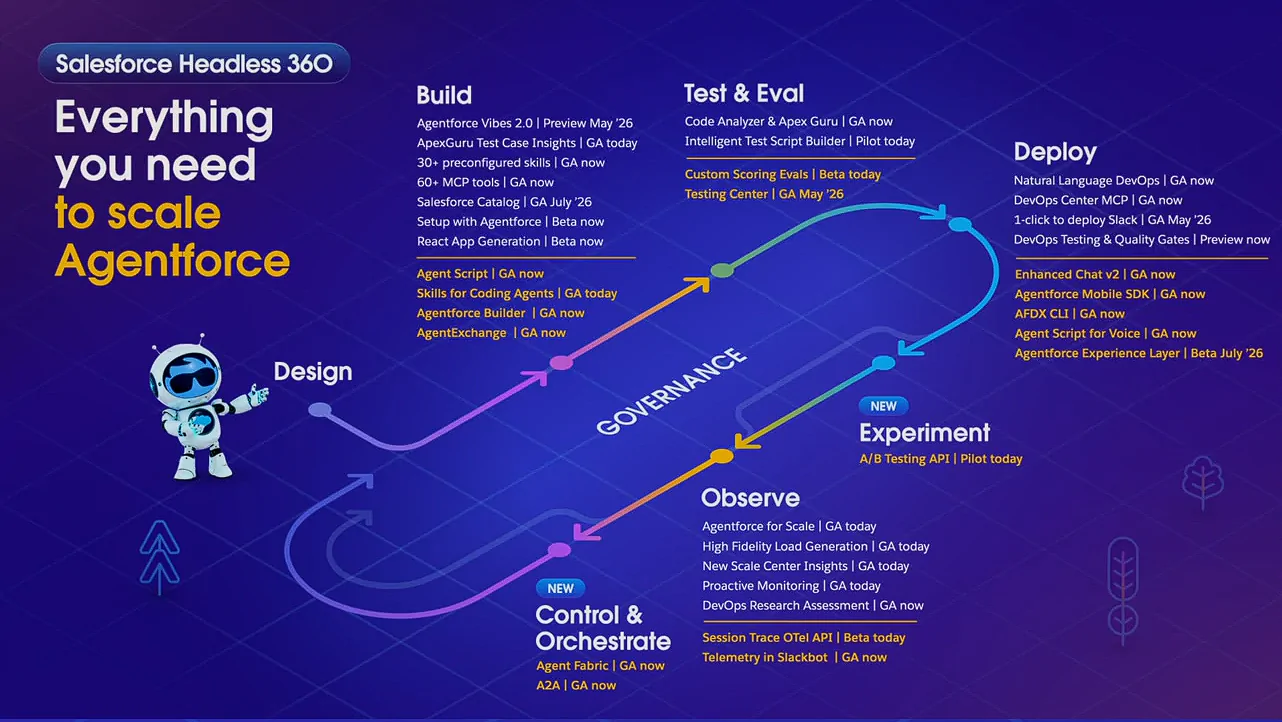
What's GA Today (as of Apr 2026)
| Feature | Status |
|---|---|
| Agent Script (open source) | GA |
| 60+ MCP Tools and 30+ Coding Skills | GA |
| Agentforce Vibes 2.0 (Claude Sonnet 4.5 + GPT-5) | Open Beta |
| Agentforce Experience Layer | GA |
| Session Tracing | GA |
| AgentExchange | GA |
| DevOps Center MCP | GA |
| Testing Center | GA in May 2026 |
| A/B Testing API | Pilot |
| Session Trace OTel API | Beta |
| Agentforce Curated Memory | Pilot |
| Agentforce Mobile SDK | GA |
Note: Licensing for the headless experience model is still evolving. Confirm with your AE before committing to customer conversations. Also confirm current availability of the SalesforceHostedMCP permission in production orgs, as this was expected to GA in mid-April 2026.
Important Notes
- Headless ≠ no UI — Parker Harris clarified in the True to the Core session that headless doesn't mean no UI; it decouples capabilities from the UI
- Licensing is still evolving — specifically for the headless experience model; confirm with your AE before customer conversations
- SalesforceHostedMCP permission was expected to GA in production orgs in mid-April 2026 — confirm current availability
Key Resources
About the author
Gourav Sood is a Salesforce Certified Technical Architect (CTA) and founder of Zenyus AI - a Salesforce implementation partner specialising in the nonprofit sector. Gourav has led Salesforce enterprise implementations and delivered complex programs across organisations of all sizes.
Gourav Sood
Salesforce Certified Technical Architect (CTA) with 19+ years of experience in enterprise technology. Gourav specializes in multi-cloud architecture and strategic consulting for the nonprofit and public sectors.
Explore Zenyus
Continue your Salesforce and nonprofit digital transformation journey with our tools, stories, and resources.
Ready to Transform Your Salesforce Strategy?
Let our Certified Technical Architect guide your digital transformation with proven expertise.
Related Articles
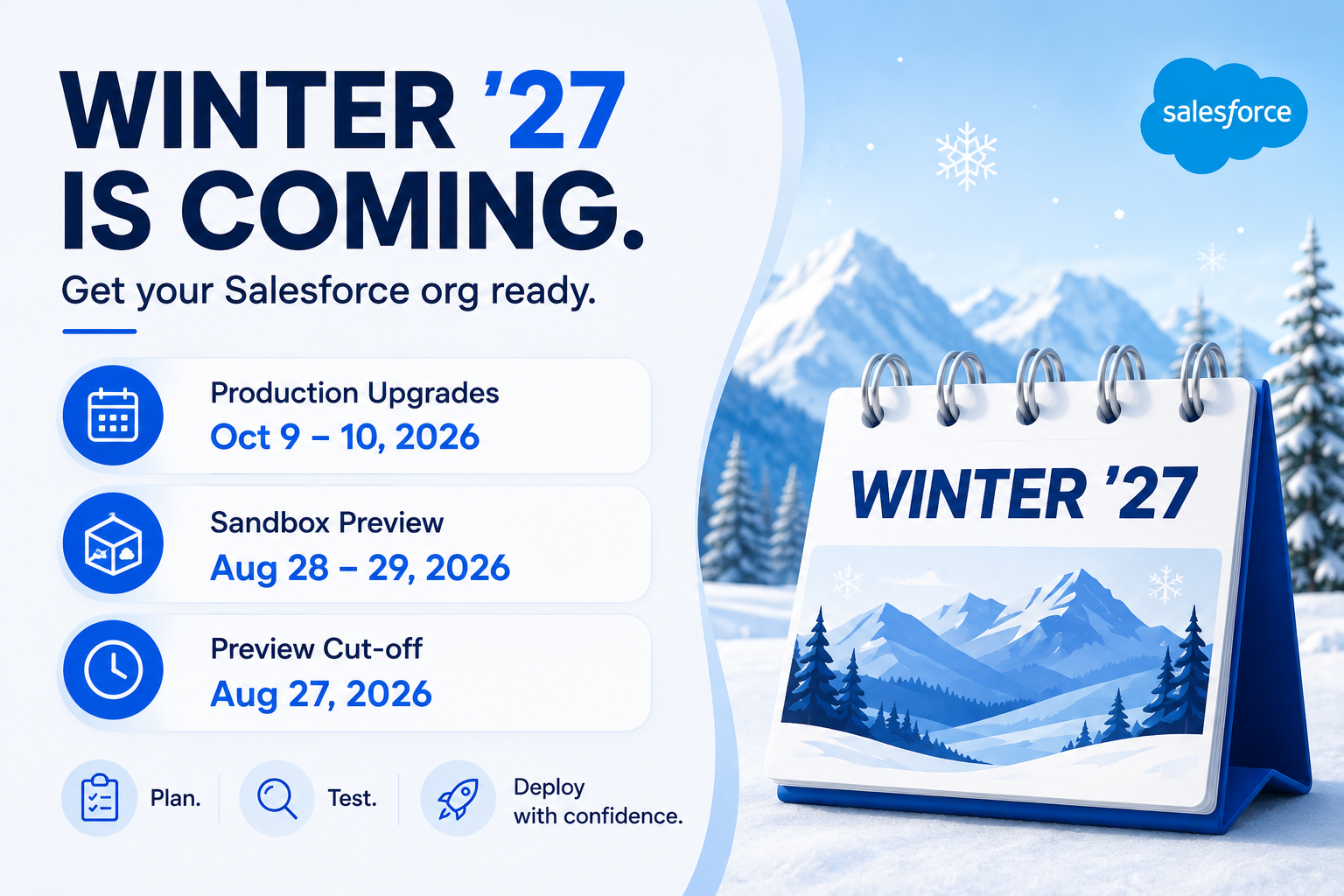
Salesforce Winter '27 Release: Key Dates and Sandbox Prep
Winter '27 production upgrades land Oct 9–10. Sandbox preview opens Aug 28 — make sure your org is ready before the Aug 27 cut-off.
10 Free Salesforce Licenses - Potential of Salesforce “Power of Us” Program.
Salesforce offers 10 free Enterprise licenses through the Power of Us program, yet many nonprofits aren't leveraging this power. Here is why you should pay attention.